
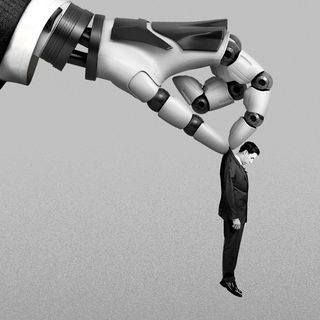
There's little evidence AI is destroying large numbers of white-collar jobs today. But five developments show the potential for massive future job and workplace disruption.
- A new report from Goldman Sachs Research warns: "AI can potentially automate tasks that account for 25% of all work hours in the U.S. This significant exposure has raised concerns around widespread and permanent job loss, sparking fears of a 'job apocalypse' or 'humans going the way of horses.'"
- Anthropic revealed this week that one of its AI tools, Claude Code, built a new product, Cowork, which allows others to use AI for workplace tasks normally done by humans — creating presentations, summarizing meetings, consolidating research. You read that right: AI built AI that will displace human work with AI. Use that for a glimpse of what's coming.
- Some top tech leaders are talking privately about losing interest in H-1B visas — the ones tech companies use to hire top overseas talent. The reason: They now assume AI will do the work.
- The Wall Street Journal reports that a hot new San Francisco startup, Mercor, has hired more than 30,000 contractors to recruit specialists, from psychologists to dermatologists, to train AI to do their jobs. The company got a $10 billion valuation for a reason.
- Elon Musk, in a new "Moonshots" podcast episode, says AI is good enough today to replace half of white-collar jobs. He also argues it's "pointless" to go to medical school except for "social reasons." Robots, he says, will be doing surgery at scale within three years.
Why it matters: Nothing will determine the future of AI, politics and employment more than if — and how fast — the new technology destroys good-paying jobs.
The big picture: So far, the job market is pretty good by historical standards, with unemployment at 4.4%.
- But it's been slowing. Many CEOs will tell you privately that they plan to run their companies with far fewer people in the years ahead. They're slower to fill open jobs and quicker to determine what roles AI will soon displace.
Most new technologies create more jobs than they destroy over time. But there's often pain in between.
- Both major parties are oddly silent about what to do about the possible jobs inferno that seems to be coming. Among the reasons they express privately: Policy experts are at a loss ... It's not here yet ... Politicians are reluctant to poke the bear on a subject that makes people queasy.
- You could sit in a room and make a huge dent in many problems if you were willing to make hard enough choices. Not this one.
President Trump thinks the problem is the opposite. He told The New York Times last week that we'll need robots just to meet labor demands.
- "I think just the opposite," he said when told many Americans are concerned that AI will take their jobs. "I think AI is going to be a tremendous job producer. I think that we have so many jobs. My biggest problem isn't taking the jobs. It's that we don't have enough people to fill the jobs, and that's where robots come in."
Put that one in a time capsule: Trump will either look clairvoyant — or careless.
- Go deeper: "The Haves, Have-Nots, Have-Lots economy."
Sign in to read the full article.
Sign in with Google