
As the Senate Banking Committee prepares to debate long-anticipated legislation that would establish regulation for the crypto industry, the fate of the bill is in limbo after Coinbase CEO Brian Armstrong declared his opposition in a Wednesday night post on X.
“We’d rather have no bill than a bad bill,” Armstrong wrote, outlining several blockchain sector critiques, including a key battle with the banking industry over offering rewards for stablecoin holdings. “Hopefully we can all get to a better draft.”
The legislation, which focuses on market structure issues such as supervisory divisions between different federal agencies, has long been a priority for the crypto industry. The bill would address thorny questions that led to bruising lawsuits under previous administrations, including how to classify and regulate different types of cryptocurrencies.
After helping elect a wave of pro-blockchain candidates fueled by millions in campaign donations, the crypto industry notched a major win over the summer with the passage of the Genius Act, which established a regulatory framework for stablecoins, or a type of dollar-backed cryptocurrency. But market structure has proven trickier, especially after the banking lobby pushed back against provisions in the Genius Act that allows companies to offer customers yield on their stablecoin holdings, similar to savings accounts.
After the House of Representatives advanced their version of the market structure legislation, called the Clarity Act, in July, the Senate delayed in taking up the bill. But with the Senate Banking Committee finally set to debate amendments on Thursday morning in the markup process, arguments over the issue of yield, as well as conflict of interest ethics provisions targeted at the Trump administration, could stymie the bill’s progress.
“There’s a real chance this could blow up in committee,” one crypto lobbyist told Fortune, speaking on the condition of anonymity to discuss sensitive industry dynamics. “People are pretty fired up here.”
Lack of clarity
For many in the crypto industry, the success of the stablecoin-focused Genius Act over the summer was just an appetizer to the main course: wide-ranging market structure legislation that would finally grant legitimacy to the renegade sector. But after years of fierce debate, the product coming out of the Senate might be worse than no bill at all.
The most significant wedge issue going into Thursday remains the battle over stablecoin yields. The bank lobby has argued that the Genius Act effectively created a loophole, preventing stablecoin issuers themselves from offering yield to users, but allowing partners and third parties to provide rewards. Those programs have been key to many crypto companies, such as Coinbase, which reported $355 million in stablecoin-related revenue in the third quarter of 2025 and offers yields to holders of its stablecoin, USDC. Bank lobbyists have argued that this could threaten the U.S. financial system by suctioning money out of bank deposits.
A bipartisan group of senators has offered a compromise in the Clarity Act, which would allow crypto companies to offer yield for stablecoin-related transactions, similar to credit cards, as well as other activity. But it remained unclear whether Coinbase, one of the most outspoken and deepest-pocketed crypto figures in Washington, would support the agreement, with Armstrong’s Wednesday post seeming to indicate it would take a hard-line approach.
Not every industry leader agreed with Armstrong. Kraken co-CEO Arjun Sethi posted on X later Wednesday night that he supported the bill. “Walking away now would not preserve the status quo in practice,” Sethi wrote. “It would lock in uncertainty and leave American companies operating under ambiguity while the rest of the world moves forward.”
“It’s still very much in negotiations right now,” said Ron Hammond, who serves as head of policy at the crypto trading firm Wintermute. “But it’s crypto and there’s always last-second drama, and so it seems to be one of the wedges here.”
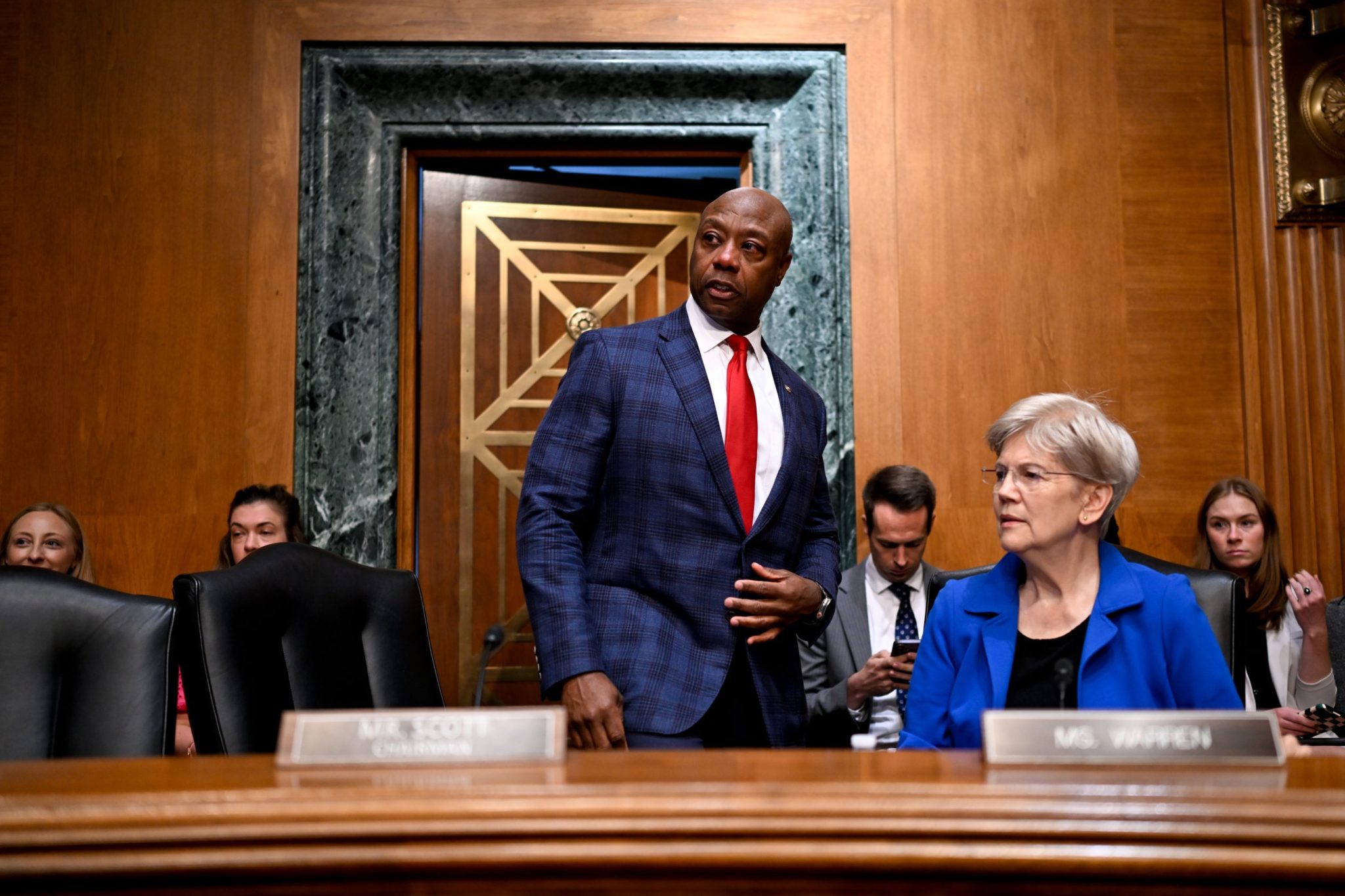
Another debate pushed by Democrats is language that would prevent politicians, including the President, from profiting off of crypto holdings or interest. The issue has become a lightning rod due to the Trump family’s deep entanglement with the crypto industry, including its digital asset platform World Liberty Financial, which recently applied for a federal bank license. But Republicans have strongly pushed back against the possibility, with Senate Banking Committee Chair Tim Scott (R-S.C.) telling CoinDesk on Wednesday that ethics provisions don’t belong in the Clarity Act.
But a letter sent to Scott and Ranking Member Elizabeth Warren (D-Mass.) from a number of nonprofit watchdog groups, obtained by Fortune, describes the lack of provisions in the proposed bill addressing governmental conflicts of interest as “deeply concerning.”
If Democrats such as Ruben Gallego (D-Ariz.), who has referred to an ethics provision as a “red line,” pull their support, the bill could be stuck in committee, which needs a simple majority vote, though Republicans hold the edge.
The lobbyist who spoke on the condition of anonymity lamented that the bill has lurched to the left in an effort to gain bipartisan support, including through additional provisions that would regulate DeFi, or decentralized finance, as well as the listing process for crypto tokens and oversight responsibilities handed to the Securities and Exchange Commission. “They’ve lost their north star,” the lobbyist told Fortune.
Update: Added comment from Kraken co-CEO Arjun Sethi
This story was originally featured on Fortune.com
Sign in to read the full article.
Sign in with Google