
Not so long ago, the Arctic—a remote and thinly populated region stretching from Alaska to Siberia—seemed immune to the kind of conflicts that beset so many other parts of the world. Scholars even had a phrase for it: Arctic exceptionalism. Territorial disputes were virtually nonexistent. Until recently, Finland and Sweden still served as buffers between an expanding NATO alliance and the Russian federation, which takes up more than half of the Arctic coastline. Over the last couple of decades, the member states of the Arctic Council reached international agreements on polar bear conservation, commercial fishing in the Central Arctic Ocean, and the rights of Indigenous peoples. The Norwegian phrase “High North, low tension,” came to serve as a kind of mantra and point of pride.

But that cooperative spirit is now a thing of the past. It has been replaced by an emerging era of competition over resources, particularly rare earth metals and control of shipping lanes, increasingly accessible as sea ice melts, and the potential for outright conflict as the United States, Russia, and China all seek to project power in the region. Russia’s invasion of Ukraine in 2022 has fractured the Arctic Council and stripped it of much of the legitimacy and influence it once had. Since then, diplomatic relations between Russia and the so-called Arctic 7—Canada, Denmark, Finland, Iceland, Norway, Sweden, and the U.S.—have deteriorated badly. Russia has officially banned all data sharing with its Western counterparts, and indefinitely suspended scientific collaboration with the U.S. and the EU. Meanwhile, China has declared itself a “near-Arctic state” and is leveraging Russia’s relative isolation on the world stage to advance its own vision of a polar Silk Road. And the U.S. has become the most openly belligerent actor in the region amid Donald Trump’s renewed threats to acquire Greenland, an autonomous territory that is still part of Denmark.
As Mia Bennett and Klaus Dodds argue in Unfrozen: The Fight for the Future of the Arctic, the sense of shared responsibility that once defined the region has all but vanished. The focus is now on security and the military buildup that goes along with it, as well as resource extraction and territorial expansion, including claims to the lucrative metals believed to lie at the bottom of the Arctic Ocean. The effects of climate change and questions related to Indigenous sovereignty have largely been placed on the back burner. And even if some sort of agreement or ceasefire is reached in Ukraine, which at this stage seems unlikely, it will not as Bennett and Dodds write, “repair the now hard-wired distrust within the Arctic state community. The damage has been well and truly done.”
The plundering of resources in the Arctic is an old story, from furs and whale oil to metals and fossil fuels, and one that has often been wrapped in depictions of the region as an empty wasteland (most famously, perhaps, Alaska Senator Ted Stevens once held up a blank piece of paper to represent the Arctic National Wildlife Refuge’s coastal plain). Its fate today is inextricably tied to the whims of its two most powerful actors—the U.S. and Russia—whose current leaders are driven by a kind of nineteenth-century vision of hemispheric consolidation and expansion. But increasingly they must also contend with a third actor, a rapidly warming climate, which is, perversely, opening up new commercial opportunities on land and sea, even as it threatens to radically upend a way of life and natural order that has existed for thousands of years.
Bennett, a geographer at the University of Washington, and Dodds, a professor of geopolitics at the University of London, have traveled widely across the Arctic for well over a decade, and the book benefits from a mix of on-the-ground reporting, much of which first appeared on Bennett’s blog, Cryopolitics, and an intimate grasp of the ecological and political changes reshaping the region.
The Arctic is warming faster than anywhere else on earth. Sea ice is disappearing and, according to some projections, the Arctic Ocean could see its first ice-free summers as soon as 2030. Warming waters are destabilizing marine ecosystems—Alaska’s snow crab population was wiped out in 2022, likely a result of increasing temperatures—and salmon runs along the state’s major rivers have crashed. And as prized species such as pollock and cod migrate northward in search of colder waters, it is only a matter of time before the Central Arctic Ocean, currently protected by an international treaty, is opened to commercial exploitation.
Back on land, permafrost is thawing, raising questions about the viability of northern settlements—about half of the Arctic’s four million people live in Russia—and the thousands of miles of oil and gas infrastructure that stretch across the tundra. Storms, fires, and landscape-scale ecological transformation threaten the subsistence-based way of life that continues to sustain northern communities (some villages in Alaska are in the process of being relocated at enormous cost). Aging pipelines and oil wells are also vulnerable, posing new risks to the environment and public health.
The changes, however, have also been viewed as a commercial bonanza. In a 2019 speech in Finland, Secretary of State Mike Pompeo described the Arctic as a land of “abundance and opportunity,” with vast mineral stores and “fisheries galore.” Diminishing sea ice—rather than a cataclysm for local hunters and the species they depend on and a contributor to rising sea levels—was heralded as opening up a new golden age of trade and shipping.
The United States has also continued to expand oil and gas development on Alaska’s North Slope, and the Trump administration recently announced that it would resume leasing and development in the Arctic National Wildlife Refuge, and vastly increase the acreage available in the National Petroleum Reserve. Russia is forging ahead with massive development projects along its Arctic coastline (Vostok and Yamal LNG, to name two) and banking on new shipping routes to send crude oil to Asia.
Meanwhile, new frontiers are being pursued. In 2024, Norway—a pioneer in offshore oil and gas development in the far north—became the first country to approve exploration licenses for deep sea mining in the Arctic Ocean, though it subsequently imposed a year-long moratorium after pushback from environmental organizations and other EU nations. But the race is on. The U.S., Russia, Canada, Norway, and Denmark (via Greenland) have all made claims, some of which overlap, to the seabed territory beyond their exclusive economic zones. This would give these countries exclusive access to the minerals or fossil fuels at the bottom of the ocean.
The search for rare earth metals and other highly prized minerals—copper, zinc, and titanium for example—needed to sustain our digital lives (and, incidentally, our advanced weaponry) also extends to land. Greenland, which is believed to possess enormous quantities of mineral wealth, has been coveted for this very reason, though very little mining is actually taking place there. In yet another ominous twist, cold climate locales are seen as an ideal place to build data centers, which are used to power the internet industrial complex and consume such vast amounts of energy that they are susceptible to overheating.
Bennett and Dodds also speculate that the Arctic may be considered fertile ground for another risky endeavor: geoengineering. Scientists are already working on ways to deflect solar radiation from reaching the poles by injecting sulfur into the atmosphere and to preserve glaciers and sea ice. One experiment, advanced by a Silicon Valley nonprofit that has since folded, involved dispersing glass beads on the surface of a frozen lake in northern Alaska in the hope that it would reflect the sunlight. Ultimately, Bennett and Dodds see geoengineering as a sign of desperation—not to mention another colonial misadventure—and one that has the potential to do enormous damage. “In pursuit of a great refreeze,” the authors conclude, “capable actors may intervene in ways unimaginable just decades ago, destabilizing the environmental and international order alike.”
Trump’s threats toward Greenland present a heavy-handed challenge to one of the more promising recent developments in Arctic politics: the assertion of Indigenous sovereignty as a potential counterweight to the zero-sum scramble for resources driven by the world’s superpowers. Greenland is more than 80 percent Inuit, and, over the last couple of decades, has sought to gain greater autonomy from Denmark, which ruled the island as a colony until 1953. Greenland manages its own domestic affairs, but relies on a block grant from the Danes to fund the government. Denmark also has control of foreign policy and security.
Under this arrangement, Greenland’s government has banned offshore oil and gas leasing and, in 2021, stymied a massive rare-earth metals mine near the southern tip of the island because of concerns over environmental contamination. Even on matters of foreign policy, it is now widely assumed that Greenland should have a seat at the table. As Múte Egede, Greenland’s prime minister from 2021 to 2025, put it in a speech in 2022 in Nuuk, “You are welcome to have an opinion about geopolitics and Greenland, but decisions concerning Greenland must be made here. Nothing about us—without us.”
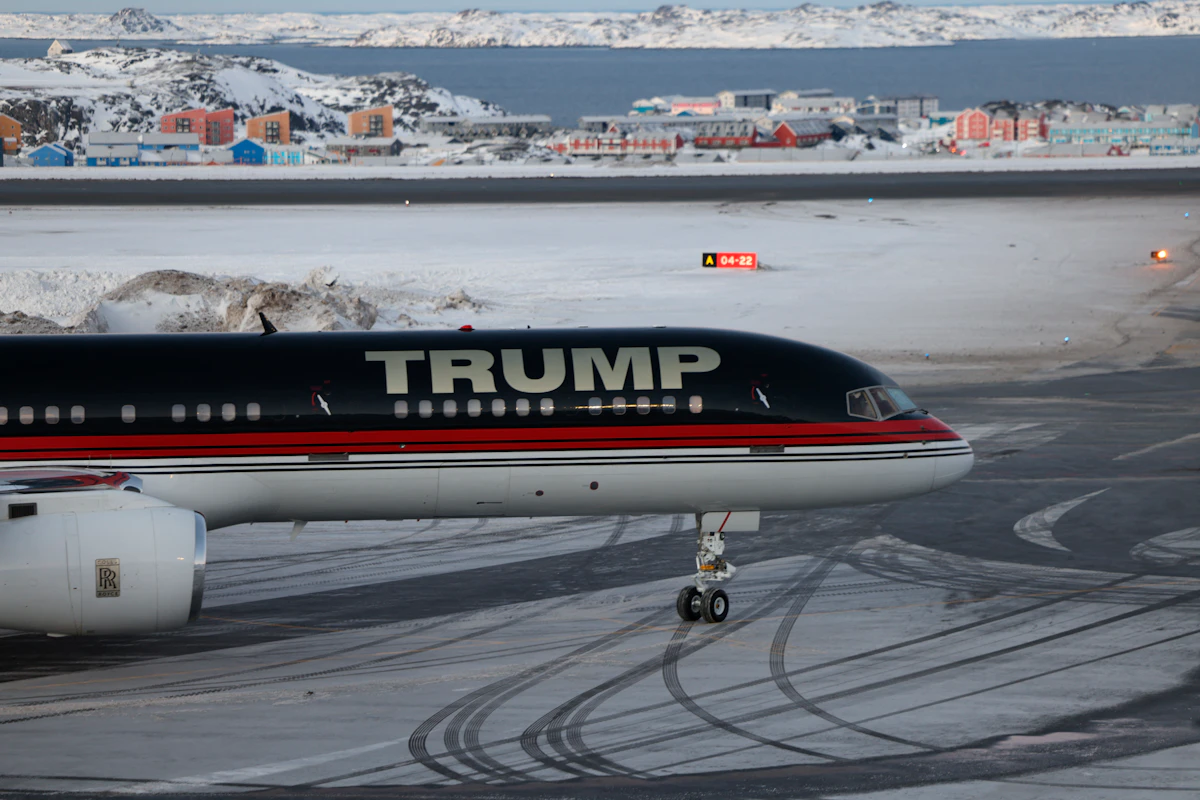
Not surprisingly, Trump’s imperial designs on the country have not been warmly received there. In December 2024, before taking office, he began musing about his desire to acquire Greenland, a strategic landmass that has been at the center of U.S. policy in the Arctic since World War II. This proclamation was followed by a semiofficial visit to the island by Don Jr., during which YouTube influencers distributed $100 bills to random people in the capital, Nuuk. At the State of the Union address, Trump reiterated his intent to “get” Greenland to make its people rich and most of all to advance the cause of “international world security,” whatever that is. In March, JD Vance, along with his wife, Usha, and then-national security adviser Mike Waltz, traveled to the U.S. military base in far northwestern Greenland. Earlier plans to attend a dog sled race and visit some of the tourist sites in Nuuk were abandoned after it became clear that residents were planning to snub the vice president.
And in the wake of the CIA’s ousting of Venezuelan leader Nicolás Maduro, Trump, his top aide Stephen Miller, and Vance have all doubled down on threats to use force to take over Greenland. Denmark’s prime minister has said any such action would spell the end of NATO, and Greenland’s leaders have flatly refused to entertain the possibility of becoming a vassal of the United States. In Trump’s eyes, according to reporting by Susan Glasser and Peter Baker, Greenland is a nice chunk of real estate with a lot of minerals and he’d like to add it to his portfolio.
As Dodds and Bennett make clear, the fight for the future of the Arctic will be waged not only in Moscow and D.C., but also in Nuuk, Utqiagvik, Karasjok, and beyond. Greenland may only have a population of 56,000, but they’ve been waiting 300 years for independence. And if the U.S. hope was to drive a wedge between Greenland and Denmark, perhaps accelerating the push for independence, it seems to have failed. If anything, the two countries have forged closer ties since Trump started making noise about annexing the island. Which leaves us facing the very real possibility that Trump, who last Friday in a meeting in the White House with oil executives to discuss Venezuela said the U.S. would take Greenland “whether they like it or not,” will do the unthinkable.
Even if diplomacy prevails, and some sort of trilateral agreement is reached (Secretary of State Marco Rubio is scheduled to meet with his Danish and Greenlandic counterparts this week), Trump’s scorched-earth approach has already done a great deal of damage. We need Greenland for national security and “world peace,” Trump has said. In reality, his actions have done more to destabilize the region than anything Russia or China could have dreamed of.
Sign in to read the full article.
Sign in with Google