
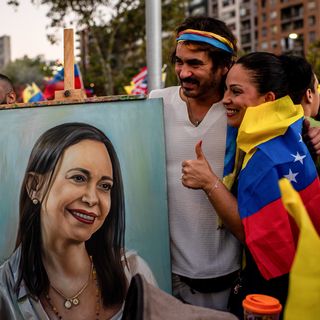
Venezuelan opposition leader and Nobel Peace Prize winner María Corina Machado is scheduled to meet President Trump on Thursday as her country's future — and her own political fate — hang in the balance.
The big picture: Ahead of the stunning U.S. raid to capture Nicolás Maduro and his wife, Machado has sought to appeal to Trump. But as the smoke cleared over Caracas, Trump held off on throwing U.S. support behind her as the country's next leader.
- "I think it would be very tough for her to be the leader," he told reporters after the mission that plucked Maduro from Venezuela.
State of play: Instead, Trump has backed Delcy Rodríguez, the country's acting leader and Maduro's vice president.
- Trump said Wednesday that he had "very good" discussions with Rodríguez and that there had been "tremendous progress" toward stabilization.
- However, recent polls have demonstrated the strong popular support for Machado.
The intrigue: More than half of Venezuelans say Machado should lead, compared to some 14% who endorsed Rodríguez, per an AtlasIntel survey published this week by Bloomberg News.
Catch up quick: In his first press conference after the U.S. operation in Venezuela, Trump said he'd like to see elections held "quickly."
- He later told the NYT it could be "much longer" than a year before the country is ready for elections.
- U.S. Secretary of State Marco Rubio gave a "threefold" vision for the path forward. Step one, he told reporters, is stabilization, with the country's acting leaders being forced to comply via the leverage of an oil "quarantine." After that, Rubio said "recovery" and "transition" would happen.
What he's saying: Reached for comment, the White House referred Axios to Trump's interview with Reuters, in which he predicted he and Machado would "talk basics" during their Thursday meeting.
- "She's a very nice woman," Trump said of Machado, per Reuters. "I've seen her on television."
Our thought bubble via Axios' national security editor Dave Lawler: U.S. officials see Rodriguez as the best candidate to reform the oil sector and comply with Trump's wishes, without alienating regime insiders, the military, and armed gangs, all of which could wreak havoc if they chose.
- Machado, by contrast, is an anti-regime hardliner who has widespread support in the streets, but many enemies within the upper ranks of the military and government.
- With no security infrastructure around her, if the U.S. backed her as leader it may have to secure her position by force, effectively becoming an occupying power, U.S. officials tell Axios' Marc Caputo.
How Machado responded to the U.S. operation
After the U.S. operation, Machado said "a big step has been taken" — but there's much left to do.
- She acknowledged to CBS News' Tony Dokoupil that there is fear that drug cartels and other groups tied to the Venezuela regime would "resist a peaceful transition."
- She said she believes that a wide majority of the military and police in Venezuela would also support an orderly democratic transition.
- Asked if she should be the person to lead Venezuela into its next chapter, she replied, "the people of Venezuela have already chosen."
Flashback: Machado won the country's October 2023 opposition primary in a landslide, but Venezuela's highest court barred her from running for president by upholding the government's decision to exclude her.
- Maduro ultimately faced off against Edmundo González, whom Machado threw her support behind. When Maduro declared himself the winner, the U.S. and other countries deemed the outcome illegitimate.
How Machado used Nobel win to court Trump
Machado has one thing that Trump has wanted for years: the Nobel Peace Prize. The Norwegian Nobel Committee named her the winner last year for her role as a "key, unifying figure" in Venezuela's opposition movement.
- She dedicated her win to Trump.
- During her first televised interview since Maduro's capture, she said on Fox News that she'd like to "share" her prize with Trump.
But, but, but: The committee shot down the idea of a shared prize, saying last week that once the Nobel is announced, "it cannot be revoked, shared, or transferred to others."
- "The decision is final and stands for all time."
Go deeper: How Venezuela is governed after Trump declared himself "acting president"
Sign in to read the full article.
Sign in with Google