
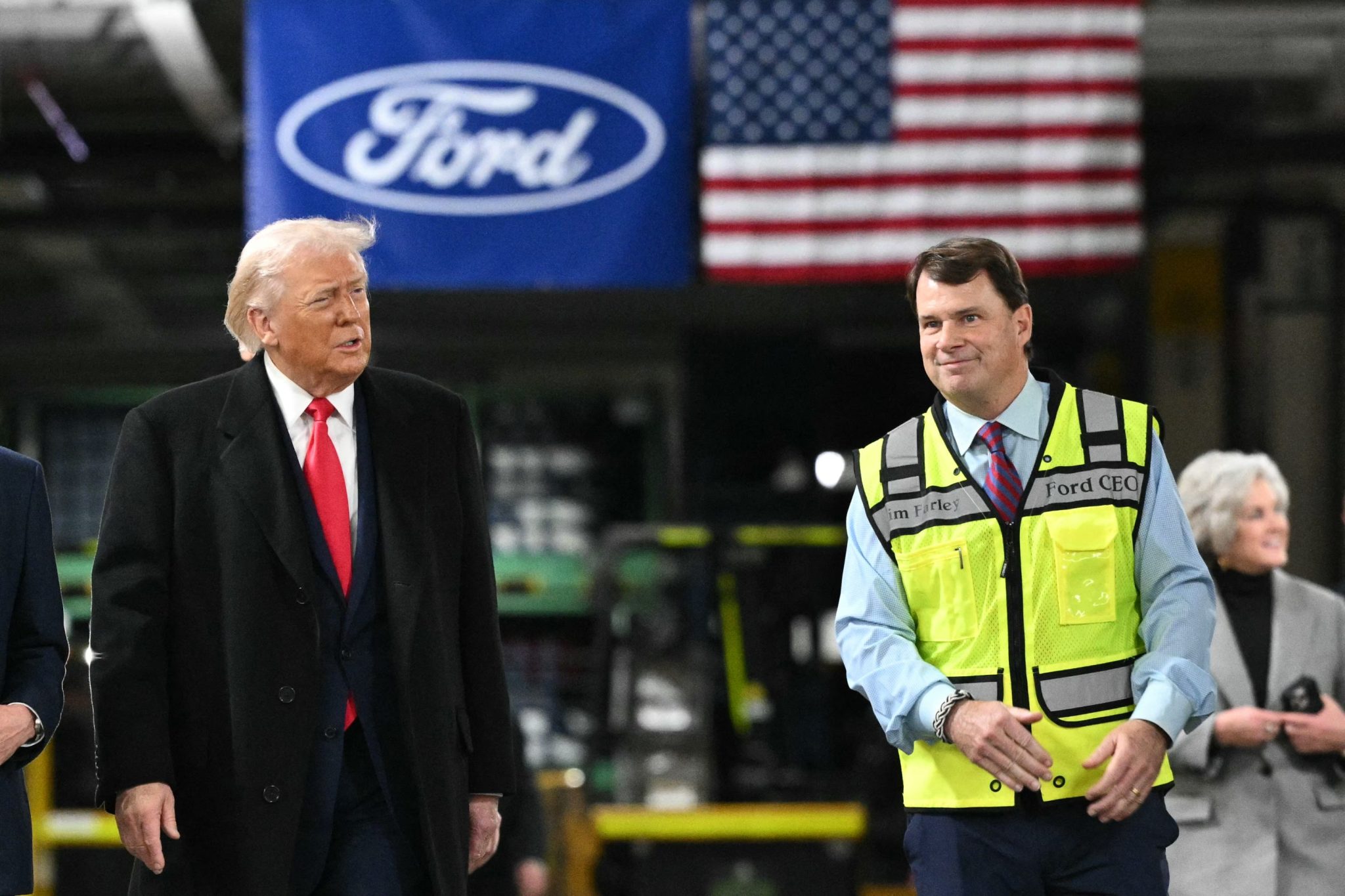
Ford CEO Jim Farley has the ear of President Donald Trump—and he has a lot to say about what the administration needs to do to support the U.S. auto industry.
Farley said in an interview with Bloomberg Television on Thursday the White House has been “great” to work with, but has several asks for how the administration can improve trade to bolster U.S. automakers.
“They always answer the phone,” Farley said. “But there is a long list of things we got to work through.”
Trump visited Ford’s Dearborn, Mich., facility on Tuesday, touring production of the F-150 truck factory, in an effort to show support for U.S. manufacturing amid growing concerns of a weak labor market. Even as American carmakers have poured billions of dollars into reshoring jobs and expanding U.S. production, domestic manufacturing jobs have continued to dwindle. Ford is making a $19.5 billion pivot away from some larger electric vehicle production in favor of less expensive and more hybrid models as it navigates lower EV demand and consumers’ affordability concerns. The move follows Trump’s killing an EV tax credit which went into effect at the end of September.
Addressing threats from Chinese rivals
The administration has made an effort to address some of these concerns, according to Farley. He praised Trump’s decision to rollback fuel economy standards and ease some auto tariffs, but said his automaker continues to be impacted by the levies—particularly those affecting aluminum, a common material in auto manufacturing. In February 2025, Farley said the tariffs would cost Ford billions of dollars, all the while serving as a “bonanza” for Asian auto manufacturing competitors.
Indeed, Farley has identified China as a top competitor to U.S. autos, posing an “existential threat,” not just because of the country’s technology prowess, but also in its labor infrastructure that supports manufacturing, explaining last September that American manufacturing is lagging behind Chinese rivals in the “essential economy,” or industries that manufacture physical goods. He called on American businesses and policymakers to invest in building a blue-collar workforce.
Farley said on Thursday China has been able to nab meaningful market share in Europe—as much as 10% in the EV market—as a result of lower prices, which he attributed to Chinese government subsidies.
“They pose a lot of threat to labor locally, they have huge subsidies from the government that they’re exporting,” Farley said. “As a country, we need to decide what is a fair playing field.”
Differing trade deal visions
Chief among Farley’s ongoing concerns was the continuation of the Canada-United-States-Mexico-Agreement (CUSMA), a trade deal that replaced the North American Free Trade Agreement (NAFTA) and which is subject to review this year. It will either be left to expire or be renewed for 16 years.
“We built our entire vehicle business as an industry between Canada, Mexico, and the U.S.,” Farley said. “We have to get this revised.”
While Trump imposed a 25% tariff on autos from Mexico and Canada last year, CUSMA has allowed workarounds for those countries to ease the burden of the levies. Farley said he wants to protect the deal, as so much of the auto industry in North America is interconnected and relies on the openness of cross-border supply chains, which is both efficient and cost-saving.
Trump, who signed the agreement in 2020, has undermined the deal, eschewing the need for cars manufactured in other parts of North America. The president’s most recent criticisms of the agreement came amid comments shortly following his tour of the Ford plant.
“We could have it or not. It wouldn’t matter to me,” Trump said. “I don’t really care about it.”
This story was originally featured on Fortune.com
Sign in to read the full article.
Sign in with Google