
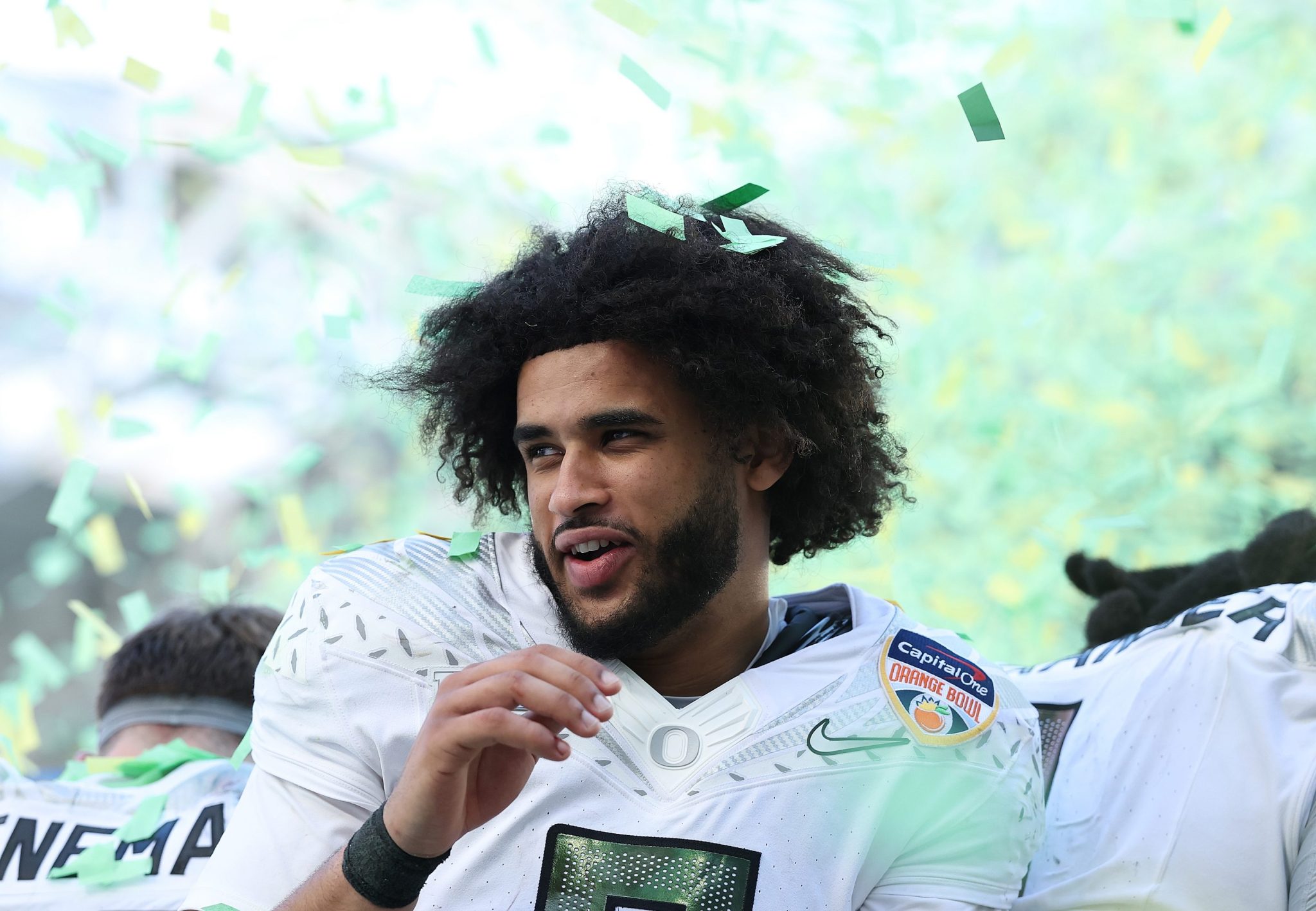
Dante Moore, the quarterback for the University of Oregon Ducks, plans to play another year of college football—turning down an eight-figure salary as a result.
The 20-year-old college athlete announced on Wednesday he would remain on the Oregon Ducks for the 2026 season, delaying the draft, where he was expected to be a top-two pick. Last year’s No. 2 draft pick Travis Hunter signed a four-year, $46.65 million deal, and this year’s projected earnings are expected to increase.
“This year, I’ve had many great throws, many great plays, but at the end of the day I feel I can still learn so much more,” Moore said in an interview with ESPN on Wednesday. “As a kid, since I was 4 years old, I’ve dreamed about being in the NFL—but this team, we’ve been through a lot, a lot of people are returning, so we’ve got some exciting things to come this year. I’m excited to keep pushing my team.”
Moore, who threw for threw for 3,565 yards and had 30 touchdowns in the 2025 season, is part of only a small fraction of college football players who have taken more time before going pro: Stanford quarterback Andrew Luck announced in 2011 he would delay NFL entry to finish his architectural design degree, allowing the Carolina Panthers to select Cam Newton as its No. 1 draft pick instead. USC quarterback Matt Leinart made a similar decision in 2005.
But Moore’s choice may mark the beginning of a new pattern among college athletes: Beyond an extra opportunity to notch a national championship, college athletes also have a shot at making real money while enrolled at school thanks to expanding name, image, and likeness (NIL) rules, taking away pressure to go pro before getting a degree or maturing as a player.
A June 2021 Supreme Court ruling made it possible for the NCAA to adopt a policy for college athletes to benefit from their own name, image, and likeness. A House settlement last summer allows for colleges to now directly pay their athletes for the first time, creating a revenue-sharing model where athletic departments could distribute about $20.5 million in NIL revenue to their athletes during the 2025-2026 season.
Cashing in on the NIL boom
Moore has already been a beneficiary of the NIL boom for college athletes, cashing in on his own deals with Nike, Beats by Dr. Dre, and Raising Cane’s. He has a net worth of $2.3 million, according to On3, making him the 12th wealthiest college football player, and the highest-earning Oregon Duck.
Moore, via a University of Oregon spokesperson, did not immediately respond to Fortune’s request for comment.
The University of Oregon has also become a dominant force in NIL, thanks to Nike founder Phil Knight—known as “Uncle Phil” to the college’s football stars—who has donated more than $1 billion to his alma mater as of 2023. Knight founded Division Street, a sports venture whose Ducks of a Feather program effectively serves as a premium marketing agency for University of Oregon’s athletes, ultimately a bid for Knight, 87, to assist in his hope of the Ducks winning another championship.
“Phil Knight is bankrolling that whole thing and wants to see them win a national title,” one unnamed NIL agent told CBS Sports. “They are really, really aggressive with money.”
NIL deals are already beginning to change the landscape of professional league drafts. The 2025 NBA draft saw the lowest number of early-entrant candidates in about ten years, with more than a dozen other high-potential candidates withdrawing at the draft deadline. Basketball analysts attributed the dip in part to the growing appeal of NIL.
Basketball insider Jeff Borzello told ESPN in May 2025 NIL has transformed how student athletes think about going pro, particularly in the NBA, where the minimum salary for rookies is $1.2 million, a number many college athletes can surpass with brand deals and revenue-sharing models. Meanwhile, students can theoretically improve their game and still maintain relationships with the NBA teams scouting them.
“With salaries for the final handful of picks in this year’s first round clocking in at below $3 million per season for the next two seasons, per the rookie scale, players projected in that range can now make just as much money by opting to stay in college while theoretically improving their draft stock,” Borzello said.
This story was originally featured on Fortune.com
Sign in to read the full article.
Sign in with Google