
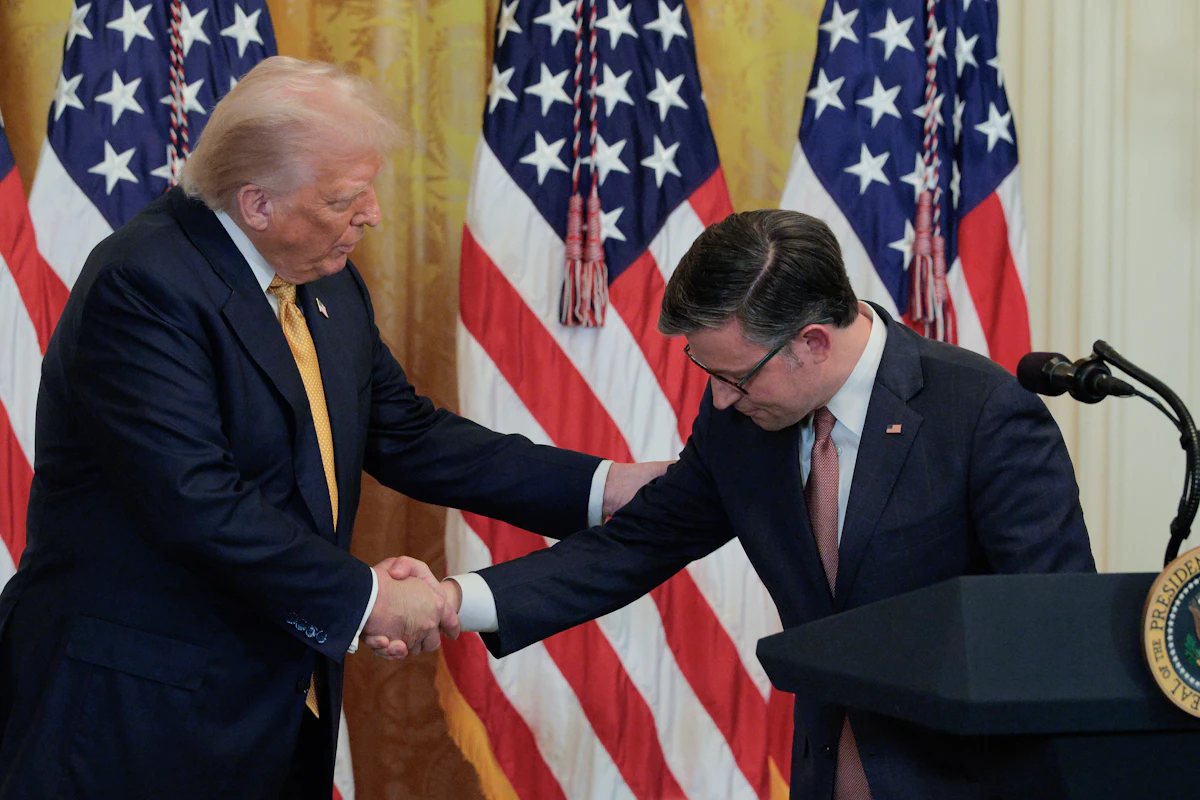
Since returning to the White House a year ago, President Trump has stretched taut the boundaries of executive power in ways both petty and consequential. Tacking his name onto the Kennedy Center in Washington, D.C., is only one of many small actions that he has taken to assert his authority, even though only Congress can legally change the name of the center. But Trump has also bypassed the body in so many other, far more significant ways: unilaterally imposing tariffs, seizing the president of Venezuela, and removing various independent officials from their congressionally approved posts.
These actions have largely gone unchallenged—and at times are even encouraged—by the Republican majority in Congress. That’s partly due to the GOP’s mostly lockstep fealty to Trump. But this is also hardly the first time a president in the modern era has pushed to expand his power, in the process straining constitutional limits and flouting the role of Congress. Indeed, Trump himself did so during his first term, joining his fellow twenty-first-century presidents in straining the bounds of executive action. But he has become bolder in his second term, going much further than his predecessors with his unprecedented and aggressive assertion of executive power. And Congress is allowing it.
The relative impotence of the 119th Congress could be seen as the continuation of a decades-long trend, one defined by the strengthening of the modern presidency and heightened partisanship. These dynamics have enabled a weak legislature—one that may struggle to re assert its constitutional mandate as a coequal branch of the government. Generally, when Congress cedes ground to the executive branch, it rarely gains it back.
“It’s not just a weak Congress. We’ve had lots of weak Congresses,” said Joanne Freeman, a history professor at Yale University. “It’s a stagnant Congress. It’s a Congress that has willingly given up its power to an executive that wants to get as much power as it could get.”
Political polarization since the 1990s has made it increasingly difficult for Congress to govern. When one party controls both the White House and Congress, lawmakers are less inclined to push back against any seizure of power by the president. In the past decade in particular, Congress has been characterized by exceedingly narrow majorities, making it difficult for the party in power to pass major legislation without employing arcane procedural maneuvers. The more lawmakers accept a president’s seizure of power for actions that merit their approval, the harder it will be to challenge him when he does something they don’t like.
“The president’s party in Congress is often comfortable with the idea that if there’s something that they want to see happen and they can’t do it legislatively, that they’re going to accept the president trying to do it unilaterally,” said Molly Reynolds, the vice president and director of governance studies at the Brookings Institute. “Once you’ve ratcheted up executive power, it’s more difficult for the legislative branch to get it back.”
In his second term, Trump has repeatedly flouted the need for congressional approval, confident in the support of an allied Congress. GOP lawmakers did not push back as the Trump administration shut down agencies that they had authorized and froze funding that they had appropriated. Resistance from Republicans has been minimal, characterized by a handful of outspoken critics and a few votes that didn’t fall strictly along party lines.
For instance, some Republicans—notably Senator Thom Tillis—have criticized the Department of Justice for targeting Federal Reserve Chair Jerome Powell this week. Last week, 17 House Republicans joined Democrats to extend Affordable Care Act subsidies (the Senate has yet to vote on it). Five Republican senators also voted with all Democrats to advance a measure aimed at blocking Trump from taking further military action in Venezuela. But these are rare exceptions; the GOP rank and file has been steadfast in supporting Trump.
Trump’s defiance of congressional oversight extends to actions that might otherwise be bipartisan. During the 43-day government shutdown last fall, he authorized the continuation of military salaries, using money that had been appropriated for other purposes. Although a measure authorizing military pay likely would have received bipartisan support, Trump took unilateral action. (House Speaker Mike Johnson had sent members home during the shutdown, an action that Democrats argued was an effort to delay a vote on the Epstein files.)
“The key problem for Congress is that they have a collective action problem. Members often agree with the president on the substance, and so they don’t want to take away a power from a president who’s doing something with it that they like,” said Matt Glassman, a senior fellow at the Government Affairs Institute at Georgetown. “Congress is usually happy with whatever the president designs. The president always designs stuff that enhances the presidency, and the president always makes a decision that enhances the presidency.”
The strength and weakness of Congress has fluctuated over centuries as the federal government has expanded. In the nineteenth century, generally a period of stronger Congresses, the purview of the executive branch was far more limited. “The federal government simply did fewer things. It did fewer things in part because our economy was less complicated, the country was smaller,” said Reynolds. During periods of high polarization in the nineteenth century, the presidency had less power.
The federal government grew significantly during the twentieth century, and so did the presidency’s power. Glassman said that over several decades, Congress “purposefully and thoughtfully ... put a lot of discretion and power into the executive branch.” During the Great Depression and World War II, Congress invested significant authority in President Franklin D. Roosevelt, allowing for an expansion of the executive branch in both size and power.
The modern military offers an example of how the executive has gained more power since the twentieth century. Since World War II, Congress has continued to appropriate military funding at high levels, most recently approving a nearly $901 billion National Defense Authorization Act late last year. The passage of open-ended Authorizations for the Use of Military Force, with limited interest in repealing them even decades later, has also permitted presidents to involve the country in foreign conflicts without congressional oversight.
“Every year they specifically decide to build a trillion-dollar army for another year,” Glassman said of Congress. “What’s the natural consequence of building a trillion-dollar army? Because the world’s really dangerous, and wars happen really fast now, the side effect is, unfortunately, that the president now has all these toys to go on little tiny wars.”
There have been periods when Congress has reasserted its power after an expansion of executive authority, notably after Watergate. But the expansion of executive authority since the September 11 terrorist attacks has not been accompanied by a commensurate bolstering of congressional oversight, added Glassman.
The judiciary has also played a significant role in weakening the power of Congress. Congress used to have a power known as the legislative veto: It would grant an authority to the president but reserved the right to overturn it with a simple majority vote that did not require a presidential signature. In 1983, the Supreme Court deemed that procedure unconstitutional.
“That took a really important arrow out of Congress’s quiver in terms of pushing back against executive power,” said Reynolds. If the legislative veto were still in place today, a simple majority vote from Congress could block Trump from taking further military action in Venezuela; it would not require his signature. This is in stark comparison to the War Powers Resolution that the Senate passed last week in a 52–47 vote. Even if the measure also passed the House, Trump would surely veto rather than sign it.
Today’s conservative-majority Supreme Court has continued to bolster Trump’s authorities, even as it has occasionally undermined the actions of previous presidents who attempted to circumvent congressional authority. The court overturned President Joe Biden’s effort to unilaterally forgive student loans, an example of a Democratic priority that was unable to pass in Congress. But the Supreme Court has repeatedly opted to strengthen Trump’s power, ruling favorably for the Trump administration in 20 out of 24 emergency docket cases in 2025. Separately, appellate judges named by Trump during his first term have ruled in favor of the president more than 90 percent of the time.
Trump already entered his second term enjoying increased authority, after the Supreme Court decision ruled in 2024 that presidents have absolute immunity for actions taken in office. Freeman said that decision was “fundamentally anti-historical”: The Framers of the Constitution were wary of executive power, given that the United States had just fought to free itself from monarchical power, and President Andrew Jackson’s attempts to abuse presidential power in the 1830s were rebuffed by lawmakers in part because the American Revolution was still within living memory.
Two and a half centuries after America’s founding, few in Congress today invoke the country’s origins in pushing back against the increasingly autocratic president. And he’s empowered not just by the blind loyalty of his party in Congress but by the fear of retribution that he has spread throughout Washington, threatening imprisonment and violence against his rivals.
“If you have people in Congress who are sitting back and not doing something, because, in part, they’re afraid to stand up and speak up—physically afraid—we’ve moved into different territory,” said Freeman. “This is a moment of extreme contingency when no one, no matter how much of a pundit they are, actually knows what’s going to happen.”
Sign in to read the full article.
Sign in with Google