
The Trump administration’s aggressive push to acquire Greenland has infuriated America’s European allies, and for good reason. It threatens to destroy the NATO alliance, what’s left of the postwar order, and could even result in the outbreak of war—especially if American troops are deployed to the largely frozen island in the North Atlantic.
That’s a lot to risk for what ultimately isn’t much of a reward. The United States gets much, if not all, of what it would want from Greenland now. The Danish protectorate hosts a U.S. military base—jointly manned by the Air Force and Space Force, it handles missile defense and space surveillance—and is reportedly open to a larger American footprint on the island. So it’s already a strategic defense site and a hub to the Arctic for the U.S.
Why, then, is President Trump so eager to acquire the island? He laid it out in an interview with several New York Times reporters last week. Pressed why “owning” was so important, Trump insisted it was “psychologically needed for success.”
“I think that ownership gives you a thing that you can’t do, whether you’re talking about a lease or a treaty,” he said. “Ownership gives you things and elements that you can’t get from just signing a document, that you can have a base.” Asked the obvious follow-up question—psychologically important for you or the U.S.?—he gave the obvious answer: “Psychologically important for me.”
It’s a revealing answer, one that explains why so much of U.S. domestic and foreign policy is an outgrowth of the president’s whims. But it also gets at something else that’s crucial to understanding the Trump administration: It is led by a man who has been consumed by real estate for his entire adult life (or really, his whole life, given that his father was also a developer). He suffers from an incurable case of Developer Brain. He only makes deals mano a mano, he’s only interested in buying and selling, and there can only be one winner.
Needless to say, it’s a ruinous approach to foreign policy from the president, who created his fair share of ruin in the real estate world too.
“Under budget and ahead of schedule.” It’s not quite as zippy as “Make America Great Again” or “Build the Wall,” but it is arguably the third-most-important slogan of Trump’s decade-long political career. Running for president in 2016, Trump touted his business experience again and again. Never mind that he was actually a terrible businessman. His supposed real estate empire was short-lived and always less substantial than Trump said it was, and he frequently left misery and destruction in his wake—stiffed contractors, scammed consumers, bankrupted businesses, and few successes. Trump had written the book on business (The Art of the Deal, the majority of which was actually written by ghostwriter Tony Schwartz) and spent much of his post-bankruptcy life playing a successful businessman on the reality show The Apprentice. Trump acted like he was a huge success—and voters ate it up.
“Under budget and ahead of schedule. So important. We don’t hear those words so often, but you will,” Trump said shortly before the 2016 election, as he opened a hotel just blocks from the White House. “Today is a metaphor for what we can accomplish for this country.” That hotel was in many ways a metaphor for what Trump would do as president. The Trump International Hotel quickly became a hub for cronyism and corruption during his first term, and then became a ghost town after he left office. It was sold in 2022 to a Miami-based developer. (Trump, I suspect, wishes he had held onto it so he could once again use it as a way for foreign governments to curry favor by splashing money on lavish rooms. But now they can throw that money at World Liberty Financial and grovel before him at Mar-a-Lago.)
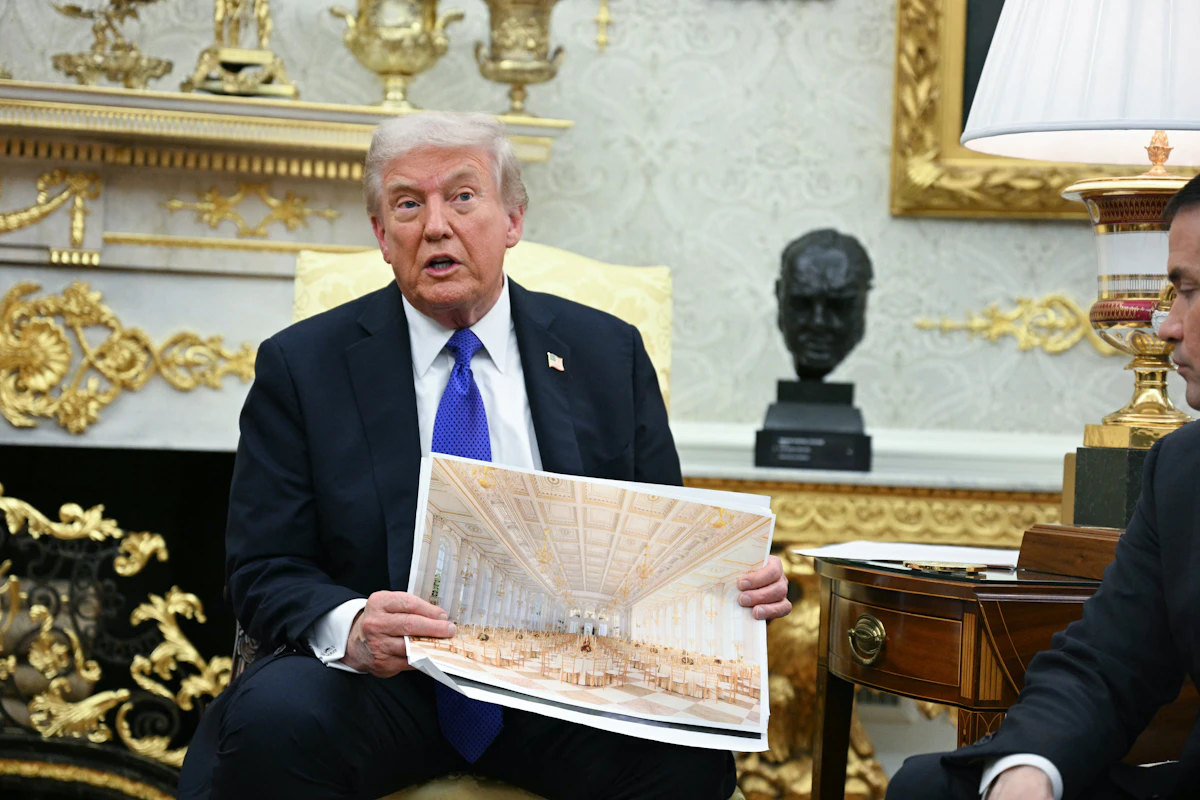
Still, Trump’s larger obsession with deals and development is at the core of his approach to politics and diplomacy. The former are zero-sum and always have clear winners and losers, while the latter must always have his own interest at the center. (Indeed, the most recent time he used the term “under budget and ahead of schedule” was in December, when he was discussing the project that may be the actual centerpiece of his second term—the White House ballroom he is currently building.)
Trump has no time for convoluted alliances like NATO, where the U.S. spends billions with no appreciable returns—not as he sees it, anyway. For Trump, the peace and stability that alliance generates are abstractions; he can only conceive of tangible gains or losses on America’s investment. That’s why the administration was quick to cut foreign aid. Trump has no time for soft power or for spending sums of money that only save lives abroad and generate goodwill toward the U.S. He favors a return to Great Power politics, partly because he respects and envies unconstrained dictators like Xi Jinping and Vladimir Putin and partly because that approach to politics makes sense to a cutthroat developer.
Even when it doesn’t involve direct ownership, as (at least ostensibly) is the case in Venezuela, Trump only sees U.S. involvement in terms of dollars and cents. Increasing oil extraction in the country will be costly and complicated, owing to its antiquated infrastructure, so much so that Exxon Mobil’s CEO called it “uninvestable.” But Trump, who recently posted that he was the “president” of Venezuela, sees things differently. He kidnapped the country’s actual president, Nicolás Maduro, so he could be a developer—specifically so he could get American oil companies to extract as much of the country’s mineral wealth as possible. He has spent much of the early part of the year devoted to doing exactly that.
Everywhere you look, Trump’s foreign policy is driven by his instincts as a developer. Last February, he posted an AI-generated video showed Gaza, then in rubble due to Israel’s genocidal post–October 7 military campaign, transformed into a glitzy resort: “Trump Gaza.” “It acts as a synthesis of Trump’s old identity as a failed casino owner and golf course peddler mixed with the authoritarian impulse to aid and abet other authoritarians,” the architecture critic Kate Wagner wrote for The Nation last year. “These obscene AI-generated ‘plans’ for Gaza communicate either an exaggerated notion of wealth (gold statues of Trump, crowds tossing US dollars into the air) or progress (solar farms, glassy buildings, and windmills).” (The creator of that video later said it was satire, mocking Trump’s “megalomaniac idea.”)
In Greenland, there’s a similar mindset. The U.S. has its strategic needs mostly met in the country, which should be enough. It doesn’t have to run the frozen country or be responsible for its people or infrastructure. But that doesn’t compute for Trump, who similarly has no interest in what the people in that nation desire for their future. Instead, he sees a vast space that he can stick his name on—and thinks not owning it is actually worse for the simple reason that, well, owning is always better than leasing.
There are, of course, other considerations at play, the biggest being what may be the main driver of Trump’s second term: his desperate attempt to build a “legacy” after the failure of his first term. But in practice, he’s doing this not by modeling his presidency after the great leaders of the past. He’s modeling it after great developers, or specifically one developer: Donald Trump. Thus far, it’s going about as well as his real estate empire.
Sign in to read the full article.
Sign in with Google