
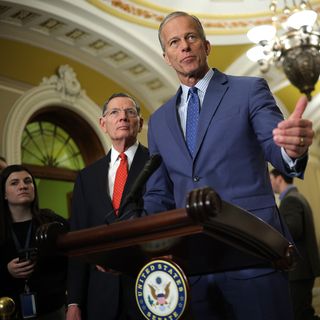
Senate Republicans successfully thwarted a final vote Wednesday on a war powers resolution seeking to restrict future military action in Venezuela.
Why it matters: It's a big win for President Trump and Senate GOP leaders, who mounted a last-minute pressure campaign to avoid another rebuke of the administration's actions in Venezuela.
- The procedural vote passed 51-50, with Republican Sens. Rand Paul (Ky.), Lisa Murkowski (Alaska) and Susan Collins (Maine) voting against it with Democrats.
- Vice President Vance cast the tie-breaking vote.
Zoom in: It came down to Sens. Josh Hawley (R-Mo.) and Todd Young (R-Ind.) who ultimately decided to support the procedural move to block the vote— despite voting in favor of the resolution last week.
- Young was promised that Secretary of State Marco Rubio would appear before the Foreign Relations Committee in a public hearing after next week's recess and assured that the administration will come to Congress first if U.S. military forces are needed in Venezuela, he said.
- He cited his talks with Rubio as influential in his decision. "To have the secretary of state be at my disposal — really, I mean, countless phone conversations and text exchanges — was very reassuring to me," he told reporters.
- Republicans have argued the fast-track voting process — which would have likely triggered a final vote Wednesday — does not apply because there are no U.S. troops on the ground in Venezuela.
Catch up quick: Rubio emphasized that there are no troops on the ground in a letter sent to Foreign Relations Chair James Risch (R-Idaho) on Wednesday morning, Punchbowl News first reported.
- It echoed arguments made by Majority Leader John Thune (R-S.D.) and GOP Whip John Barrasso (R-Wyo.), and appeared successful in swaying Hawley and Young who had also been hearing from Trump, Senate leadership and top administration officials on the issue.
- Democrats used a similar tactic in 2024 to avoid a vote on Sen. Ted Cruz's (R-Tex.) war powers resolution focused on the U.S.'s humanitarian pier in Gaza.
Sign in to read the full article.
Sign in with Google