
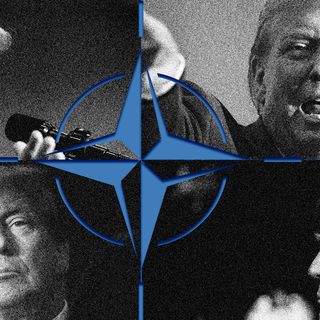
NATO allies are increasing their military presence in Greenland against the backdrop of a growing threat: President Trump's takeover push.
Why it matters: Europeans say the military buildup is meant to counter general Arctic threats, but U.S. aggression towards a NATO-backed ally creates a relatively unprecedented scenario: planning to repel an attack from within.
Driving the news: Germany, Sweden, Norway, France, U.K and the Netherlands are among the countries increasing their military presence in the country.
- European nations began mobilizing forces for joint "exercise activity" in Greenland on Wednesday, according to the Danish Armed Forces.
- The stated goal is to train troops to operate in "unique Arctic conditions" and strengthen NATO's footprint in the area.
- Activities could include guarding critical infrastructure, hosting allied troops, deploying fighter aircraft and naval operations.
- Germany said Thursday that specific contributions were not outlined yet, framing the move as exploratory to keep transportation and trade routes free.
Catch up quick: Trump has made his ambitions plain, saying Wednesday that NATO shouldn't stand in the way of the U.S. taking control of Greenland, an autonomous territory of Denmark, a longtime U.S. ally.
- "Militarily, without the vast power of the United States ... NATO would not be an effective force or deterrent," he wrote on Truth Social.
- "They know that, and so do I. NATO becomes far more formidable and effective with Greenland in the hands of the UNITED STATES."
Here's what to know about NATO members' obligation to defend their allies:
What NATO's charter says about collective defense
Article 5 of NATO's charter says that an armed attack against one member is considered an attack on all.
- That requires members to take any actions deemed necessary, including military force.
The fine print: The treaty has "wiggle room" that doesn't explicitly require members to engage in combat, Charles Kupchan, who served on the National Security Council during the Obama and Clinton administrations, tells Axios.
- "They could send a harsh letter of protest to the capital of an aggressor country."
- He says that wouldn't violate the charter, but in theory countries are expected to respond as if they were attacked, which "implies that the use of force should be used."
What if one NATO member targets another?
Article I of the treaty requires members to settle disputes "by peaceful means," so the treaty is "premised on the assumption" that conflict will not happen, Stephen Wertheim of the Carnegie Endowment for International Peace tells Axios.
- However, there is no specific provision to expel or suspend a misbehaving country.
- "Countries can voluntarily leave, but they cannot currently be kicked out," Wertheim said.
Case in point: Greece and Turkey have repeatedly clashed over territorial issues going back centuries, according to the Carnegie Endowment.
- Those skirmishes have always been brief, limited, and ultimately settled diplomatically.
Zoom out: When member states have disputes, it's better for NATO's security to let diplomacy play out.
- "You wait for the political pendulum to swing back," Kupchan said.
- NATO doesn't want to lose influence over the misbehaving country, or risk pushing it toward adversaries such as Russia or China, he said.
Go deeper: Trump's Greenland threats put transatlantic alliance on death watch
Sign in to read the full article.
Sign in with Google